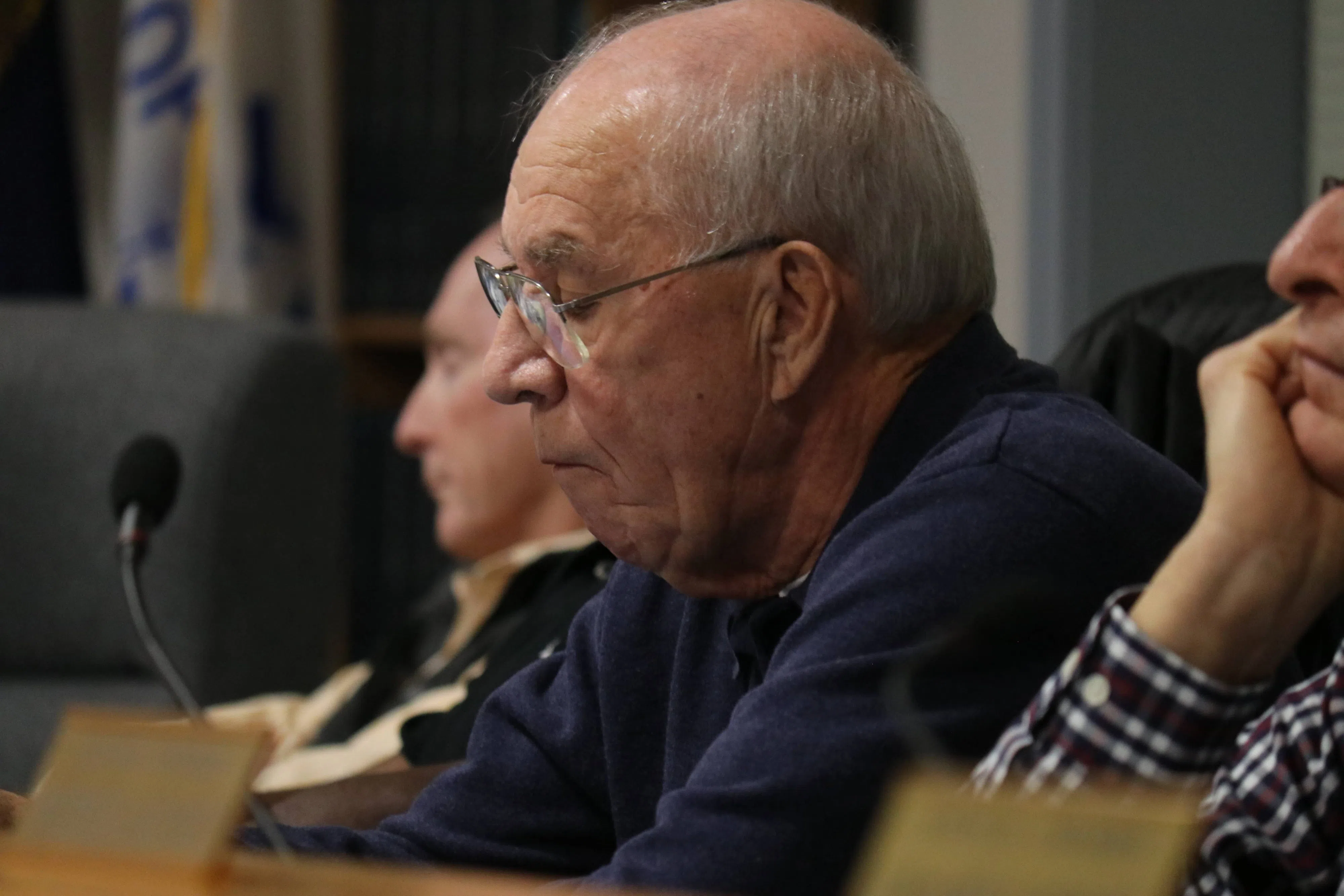
Marlin Witcher, a Glasgow City Councilperson and member of the Glasgow Electric Plant Board, examines a page of his meeting agenda at a council meeting on Monday, Nov. 25, 2019.
GLASGOW, Ky. – Three Glasgow Electric Plant Board members voted Tuesday evening to permit a Lexington-based law firm to begin a lawsuit against the Tennessee Valley Authority.
Warren J. Hoffman and Barry D. Hunter, attorneys with Frost Brown Todd law firm, were present at the Tuesday meeting. The counsel filed documents Wednesday in Western Kentucky District Court.
The lawsuit stems from disagreements with a Long Term Agreement contract that was signed on Nov. 27, 2019.
The contract was signed following a 3-2 vote by the former board. Libby Short and Tag Taylor voted to sign the agreement along with former board member Jeff Harned. Froedge and Witcher voted in dissent.
But the majority of the board flipped early last year when Pritchard was appointed after Harned’s term expired.
Now the new majority is seeking to leave that agreement at a time when Glasgow is at a crossroad regarding its economic growth.
“It is not to be taken lightly, and to get into it without the option of getting out is absolutely insane,” Froedge said.
TVA provided the LTA to many of its Local Power Companies or “LPCs” like the GEPB.
Taylor and Short have reasoned the city’s relationship with TVA is essential for economic growth due to certain incentives in the contract.
One of those incentives is a 3.1% rebate, or approximately $4,500, each month. The utility provides that rebate in whole to Community Relief each month to aid the community with electric bills.
Short said TVA is providing between $170,000 and $180,000 for the next three years to support the development of the new South Cooper Industrial Park.
Short also said the supplier was “instrumental in getting CATL here,” which a Chinese-based battery factory that purchased the former LSC Communications building.
“CATL is counting on us to be in a Long Term Agreement, which does include this Flexibility Agreement,” Short said.
William Ray, the superintendent of the GEPB, said the battery company agreed to locate to Glasgow because of certain incentives offered by TVA. One of those incentives permits the company to extract power to charge battery products in the facility from “the grid” and return it upon discharging those products.
“That’s been offered to them, and they have accepted that offer as a part of their decision to purchase the property,” Ray said.
Froedge continued to reason Tuesday that those incentives do not outweigh the consequence of engaging in a long term agreement, which he said would cost the EPB more than what they receive from the deal.
“The only option a little operation like we have is the option to leave,” Froedge said. “This precludes this option. You can’t leave. You just pay for whatever they want. And to sit here and take it is just precluding all the future boards from having any options at all.”
Short said the “handful of ratepayers” impacted by what they reason are expensive electric bills is not worth seeking an exit from the contract.
“DT, this does not just affect a handful of ratepayers,” Short said. “This affects all of Glasgow, Barren County and surrounding counties to get this industry here.”
The LTA included a “Power Flexibility Agreement,” which allows the utility to generate 3-5% of its own power. But language in the LTA specified that the GEPB could terminate the agreement if TVA didn’t provide a power flexibility solution by Oct. 1, 2021.
TVA sent a Power Supply Flexibility Agreement to the GEPB. Taylor, who was the board’s chairperson at that time, signed the agreement on July 6, 2020.
“This board did not offer its word. There’s some people here that did and sent this contract off without approval of this board,” Froedge said. “It’s going to be expensive to get it back, but because of the negligence involved in signing on to it – which we wouldn’t have – it’s going to be expensive. But compared to the 20-year contract, it’s a very small sum of money.”
Taylor sought information regarding the “strengths” the attorneys felt the GEPB has against TVA. He said he wanted to know before the money was spent to pursue the litigation.
Hunter, one of the attorneys representing the GEPB, said he would not explain the lawsuit’s “strategy” in a public setting, but “thinks we have a reasonable chance of success.”
Taylor then suggested the board enter closed session to discuss the pending litigation, which is permitted by KRS 61.810(c).
The vote failed.
Witcher, Froedge and Pritchard voted against entering closed session to discuss those details.
A formal motion was made to accept the fee schedule, and the engagement as a whole, put forth in the engagement letter. The flat rate for attorney time and engagement is $495/ hour. Paralegal time is $170/ hour.
DT Froedge, Marlin Witcher and Glenn Pritchard favored the motion. Short and Taylor voted in dissent.
Taylor voted with an emphatic “hell no,” which was ironic considering that Froedge voted that same way when the motion was called to accept the LTA in 2019.