





By Auggie Brown
Glasgow News 1
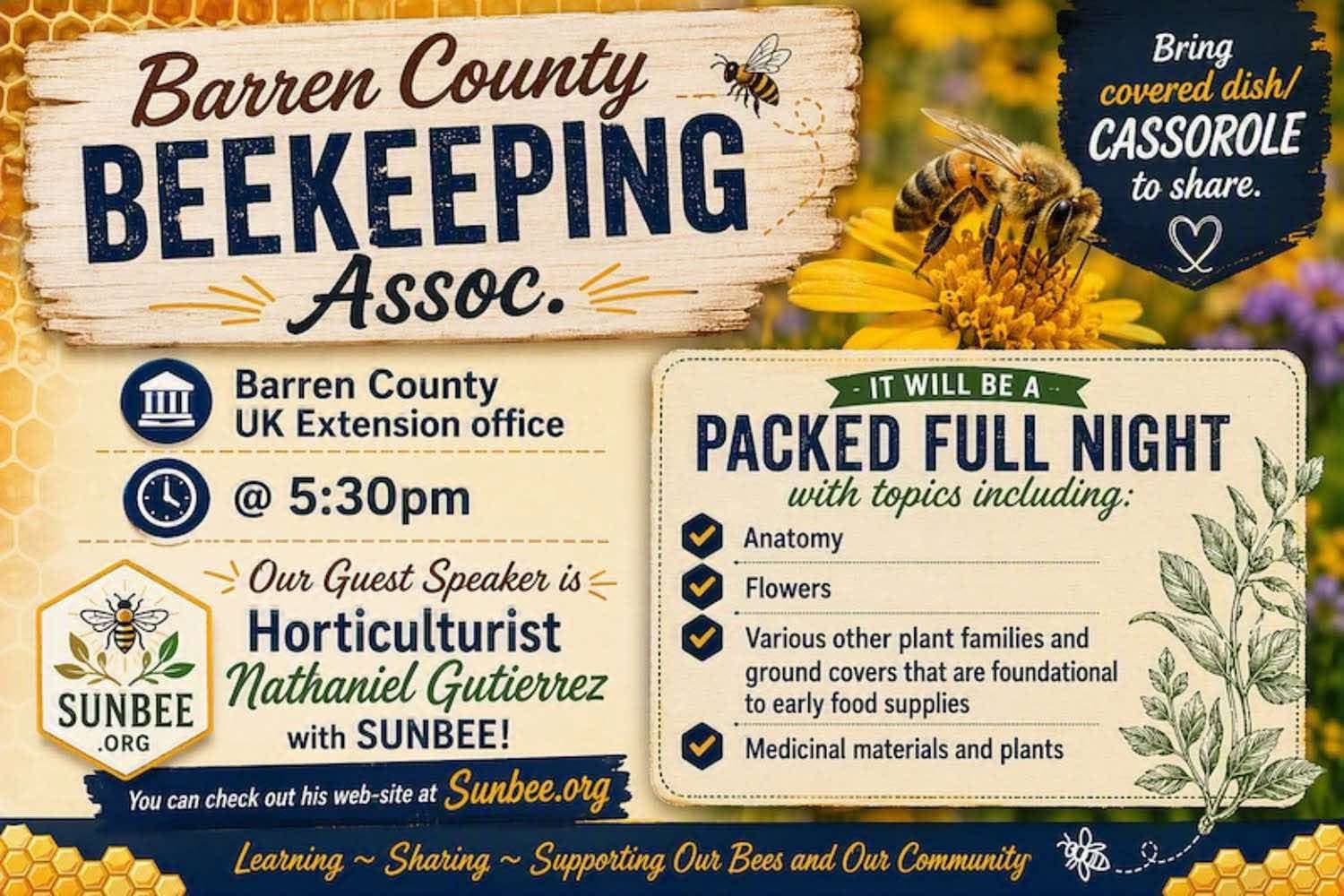
Barren County beekeepers spent their Monday evening learning how to design gardens that work better for bees and honey production.
The Barren County Beekeeping Association met at 5:30 p.m. Monday, Sept. 28, at the Barren County Extension Office, where about 15 people gathered for food, conversation and an in-depth presentation on bee-friendly gardening.
Horticulturist Nathaniel Gutierrez led the talk, explaining why pollination and honey production are closely tied to which plants beekeepers and gardeners choose.
Gutierrez said bees are drawn to nectar and pollen, with nectar providing carbohydrates and pollen serving as a protein source.
He told members they should look for plants with high nectar production and loose pollen that is easier for bees to collect.
The group heard that compound flowers and large clumps of the same plant are especially beneficial, because bees show what Gutierrez described as floral fidelity, preferring to work one type of flower at a time.
According to Gutierrez, tight or double-petal flowers can make it harder for bees to reach pollen and nectar, while big patches of simpler blooms offer more efficient foraging.
Gutierrez highlighted several early-season plants that can help bees at the start of the year, including wild strawberries, wild clover, wild violets, purple dead nettle and other ground covers.
He also pointed to crocus, which can bloom in late winter and very early spring, as an option for adding early color and food, although it usually requires many bulbs to cover a large area.
The presentation covered a variety of popular garden flowers, noting that lilies tend to have loose pollen and can grow in large clumps, making them useful in bee gardens.
Members also heard about tulips, daffodils and other plants in the broader asparagus-related family, as well as mallows such as hibiscus and rose of Sharon, which can be trained as either a bush or a small tree.
According to Gutierrez, some beekeepers also look to figwort and members of the compound flower family, including rudbeckia, marigolds, zinnias, dahlias and echinacea, to provide nectar and attract pollinators.
The group discussed how garden size and plant selection can influence how much nectar bees can gather, including the idea that a roughly one-eighth-acre garden can be a practical size for honey production.
Before the talk began around 6 p.m., members traded beekeeping stories and tips, and food was available, including casserole, cookies and coffee.
Attendees also talked about future projects, including a proposal to convert a storage facility behind the meeting site into a honey extraction facility.
Key facts:
– Barren County Beekeeping Association met Monday at the Barren County Extension Office.
– About 15 people attended the meeting, which began with social time at 5:30 p.m.
– Horticulturist Nathaniel Gutierrez led a presentation on plants that support bees.
– Gutierrez emphasized high-nectar, loose-pollen flowers and large clumps of blooms.
– Early spring plants such as wild strawberries, clover and crocus were highlighted as key food sources.
– Members discussed ideas for turning a storage building into a honey extraction facility.
– Food and coffee were served, and members traded beekeeping tips before the talk.



Comments