


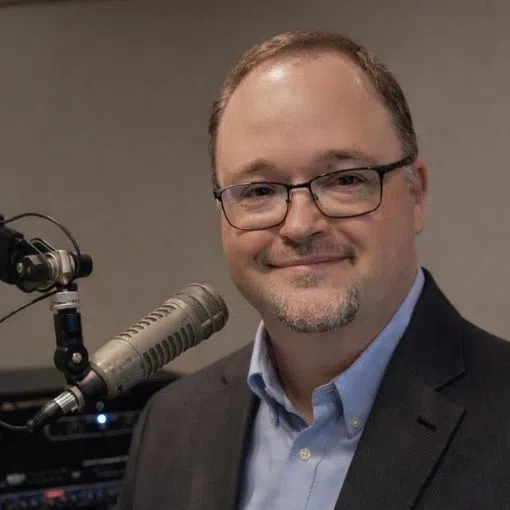


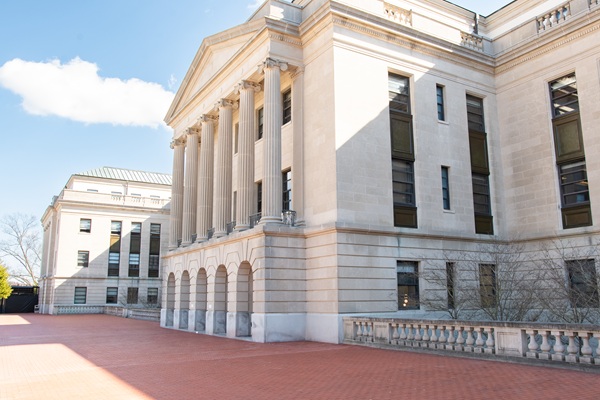
Courtesy of Legislative Research Commission
Glasgow News 1
FRANKFORT — Kentucky lawmakers on Tuesday learned about details surrounding a legal settlement between the commonwealth and Meta technology company that’s expected to result in at least $358 million in payments to the state.
During a meeting of the Interim Joint Committee on Health Services, two officials from the Kentucky Office of the Attorney General explained how the case originated, what Meta must do now and how the multistate consent judgment measured against New Mexico’s trial judgment.
They also discussed what Kentucky is expected to be paid and how the general assembly is connected to the settlement. Meta owns and operates Facebook, Instagram and other applications.
“Nationwide, monetary was just short of $17 billion. Kentucky will receive a guaranteed payment of $358 million and change with a contingent payment of $154 million and change that can come at a later date,” said Chris Lewis, division chief for consumer and senior protection for the attorney general’s office.
Lewis said the payments will be coming in $35.8 million increments with the first payment arriving at the end of this month and the second coming in January. Payments will follow in January each year after that, he said.
Under the settlement, Meta must have more accurate age assurance for users under 18 and require greater detection of those under 13 who “often fake accounts that are legally not supposed to be on the platform,” Lewis said.
The settlement also calls for time management tools – most likely the flagship is a nighttime block that will be in place during hours when adolescents should be sleeping – when a lot of mental health issues come up due to sleep deprivation, he said.
There will also be an option for a nonalgorithmic, nonpersonalized feed to stop what is colloquially called “doomscrolling,” and social comparison will be limited and eliminated in some instances.
“Likes” will not be available for adolescent users. Additionally, cosmetic filters – ones that mimic cosmetic surgery and have been known to cause body dysmorphic problems with adolescents – will be blocked for underaged users, Lewis said.
“Also, increased parental supervision tools are going to be in place and more accessible, and I think the main thing for all of us is going to be the final piece, which was an independent auditor which Meta has agreed to, Meta will be paying for,” he said. “And that auditor, for a period of five years will be monitoring their compliance, their efforts on this, and reporting back to a committee of six states.”
During the 2026 Regular Session, House Bill 686 was proposed to create the Kentucky Positive Youth Development Commission.
Committee co-chair, Rep. Kimberly Poore Moser, R-Taylor Mill, said the bill will receive a new number in the upcoming session. It will call for a stakeholder group to complete needs assessments and determine needs for communities, she said.
Committee co-chair, Sen. Stephen Meredith, R-Leitchfield, said it’s important that the wellbeing of children is kept at the forefront.
“These funds are different from the opioid settlement in that it does go to the general fund. So, I think there’s general consensus among all of our legislative members to make sure these funds are used for the intended purpose of protecting our youth in mental health situations. This bill is one attempt to try to address that,” he said.
Rep. Rebecca Raymer, R-Morgantown, said she agrees with the proposed bill and is “very supportive” of it.
Rep. Adrielle Camuel, D-Lexington, said social media, artificial intelligence and emerging technology are expanding rapidly and they affect every corner of Kentucky.
“There is not a child in the state who is not impacted in some way, and I just want to make sure we cover every bit of Kentucky to make sure we’re doing everything we can to help all the kids,” she said.





Comments