




STAFF REPORT
Glasgow News 1
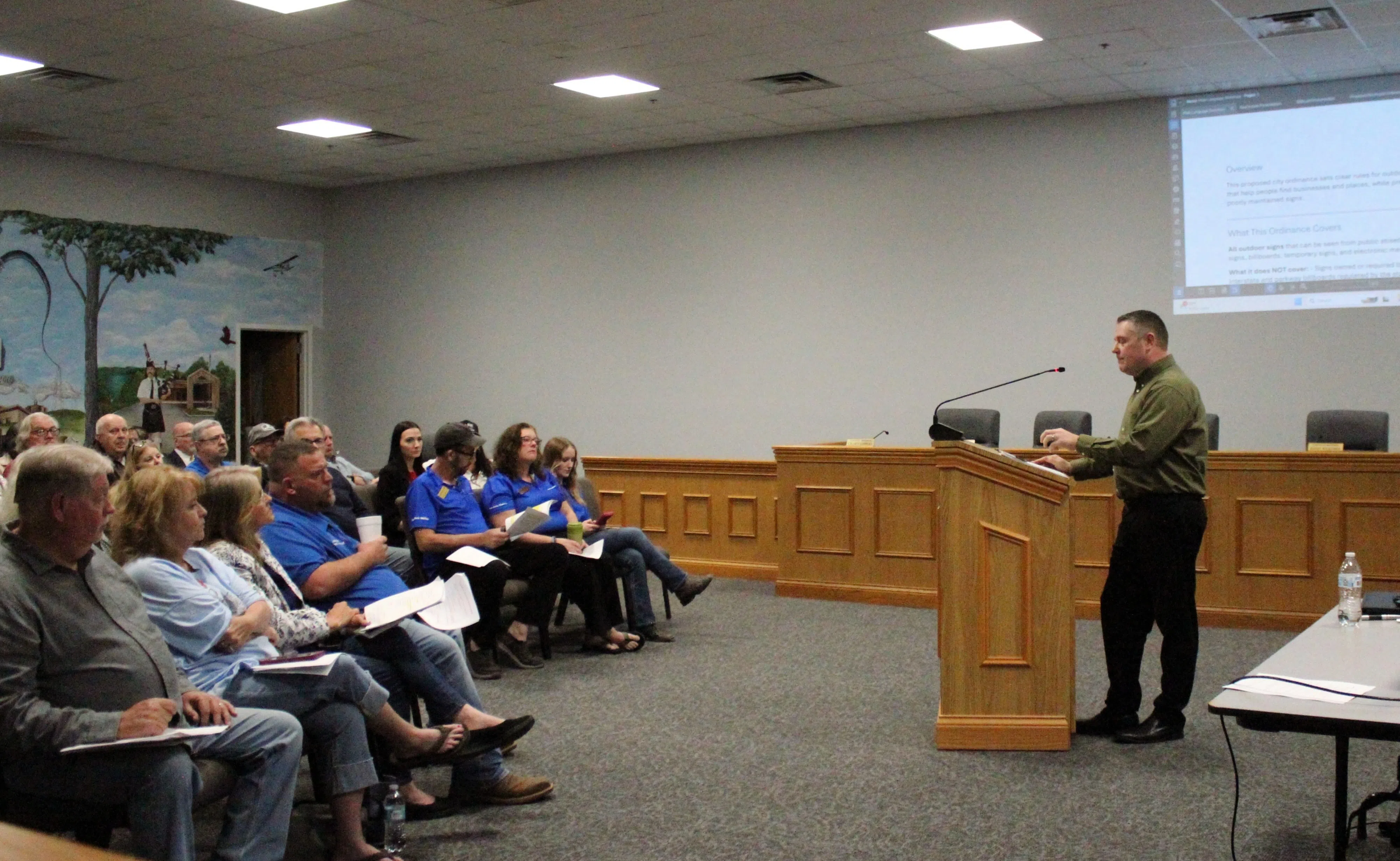
The City of Glasgow hosted a town hall Thursday evening to hear from community members who may be affected by a proposed ordinance regulating signage within city limits.
Joint City-County Planning Director Kevin Myatt and City Attorney Rich Alexander fielded questions from the front of the room, taking note of concerns that could require revisions before the ordinance advances.
“To put any fears to bed,” Myatt said, “this is not going to be on Monday night’s [city council] agenda.”
Myatt went on to outline how the proposed ordinance would regulate real estate and auction signs, which would now fall under the category of “temporary signs.”
Under the changes, real estate signs would be permitted in all zoning districts but could only be placed on private property – not within the public right-of-way, as is the case currently. Signs could be positioned at the end of a street intersection if the private property owner grants permission, but they cannot be placed within what the ordinance calls a “visibility triangle.”
The visibility triangle is a safety buffer at intersections designed to protect drivers’ sightlines. At standard street intersections, the protected area extends 90 feet in each direction from the center of the intersection, according to Myatt. Within that triangular space, no objects –- including signs –- are allowed if they would obstruct visibility. Smaller “triangles” apply where driveways and alleys meet streets, ensuring drivers can clearly see oncoming traffic before pulling out.
Prompted by a question from the assembly, Myatt explained that signs already placed would be “grandfathered-in” as existing non-conforming structures, essentially as long as they are well maintained and are not altered in a meaningful way, then they will not be subject to the restriction placed within this prospective ordinance.
“Anything that is in place now stays,” explained Myatt, citing Kentucky Revised Statute 100, which allows a legally existing use or structure that does not conform to new zoning regulations to continue operating as a “nonconforming” use. “State law will not allow me to remove them,” he said.
“It’s pretty straight forward about it,” Myatt added.
Auction signs would be allowed up to 30 days before a sale and must be removed within 48 hours after the event. Like other estate signage, they cannot be illuminated, are limited to 32-square-feet in size, and may not advertise property located outside the city limits. The same rules would apply to estate sale signage under the proposed ordinance.
Of particular concern was the restriction on off-premise advertising, meaning businesses and organizations generally would not be allowed to advertise events taking place outside city limits. The ordinance does allow for certain exceptions, including billboard advertising that complies with regulations and signage related to property for sale.
Myatt also stated during the discussion that “community events” would still be permitted under the ordinance, though clarification on how those events are defined may be necessary moving forward.
“For sale” signs would also have a special exception should they be on the property up for sale. “A ‘For Sale’ sign is not for an auction; it does not have a set date,” added Alexander.
As one speaker noted – and later Myatt confirmed – any sign that meets the ordinance’s standard, on personal property, may be left up in perpetuity.
The meeting ran for two hours, from 5 p.m. to 7 p.m. with open discourse dwindling toward the end.
Councilwoman Elizabeth Shoemaker, who encouraged this proposed update, was happy to see community members engage with local government.
“Most of the people here are the people these changes really affect,” she said. “I’ve heard concerns from residents about the signs, and how it affected their visibility. So it made me think about pedestrian and driver safety, as well as beautification and overall fairness.”
Alexander noted that the proposed ordinance as written would be reviewed by Myatt and his team, taking into account the comments and questions brought forward by the public, before the ordinance would arrive before the council for its first reading.
The document can and, most likely will, be modified and amended as its passage begins. No timeline was given for when this ordinance would be presented.
Key Facts:
– Glasgow hosted a two-hour town hall on a proposed sign ordinance
– Planning Director Kevin Myatt and City Attorney Rich Alexander answered questions
– Drafted rules target temporary, real estate, auction and estate sale signs
– Real estate signs would be limited to private property, not public right-of-way
– A “visibility triangle” around intersections would bar signs that block sightlines
– Event signs – including auction signs – are allowed 30 days before a sale, removed within 48 hours after
– Off-premise advertising would generally be restricted, with some exceptions
– Existing compliant signs would be grandfathered under state law
– Councilwoman Elizabeth Shoemaker says safety and fairness are key goals
– No timeline has been announced for council action
Gage Wilson with Glasgow News 1 contributed to this reporting.






Comments