

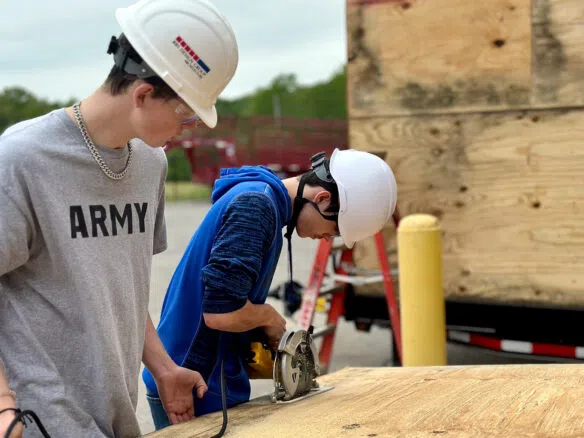
CTE empowers Kentucky’s future workforce as they learn skills and trades. A tiny house built by students in Barren County is one example of CTE’s real-world application. Photo by Wallace Caleb Bates, April 27, 2023
By Caleb Bates | May 11, 2023 KentuckyTeacher.org
Barren County is like many rural areas throughout the Commonwealth of Kentucky: a close-knit community with a trades-based economy. Recognizing this, community leaders, including fiscal court officials, came together with a task for Barren County Area Technology Center students.
The automotive, carpentry, electricity, heating, cooling and ventilation (HVAC), plumbing and welding students are collaborating on a community-based project to provide housing for those in need: a tiny house that will feature a kitchen, sleeping area, sitting area, bathroom and more. Each element that goes into creating a comfortable living space requires each program’s expertise.
When natural disaster struck in 2021 in western Kentucky, including communities just 30 minutes west of Barren County, students saw families leaving their properties for hotel rooms in Paducah and other distant cities. One of the goals of the tiny house project focuses on keeping victims in such times of tragedy close to home – on their own property, even.
The tiny house sits on a trailer parked behind the ATC for easy access, allowing programs to work on it without commuting long distances. The tiny house will create a semblance of home in areas across the county, depending upon where people’s needs arise.
The project focuses on traditional content found in ATC courses, but it also aims to teach aspiring tradespeople about the importance of using their skills to help others. Jonathan Myatt, an instructor at Barren County ATC, said of teaching students a trade, “Ultimately, we want to prepare these students for when they graduate. This gives our kids the opportunity to give back.”
Ashley Burd, who is in her 13th year as principal at Barren County ATC, said the project goes beyond the ATC and its teachings, even beyond the students themselves.
Burd said, “It allows students to be a part of something bigger than themselves. They get to see that sense of ‘I’m doing this not only for my class but for the community.’”