

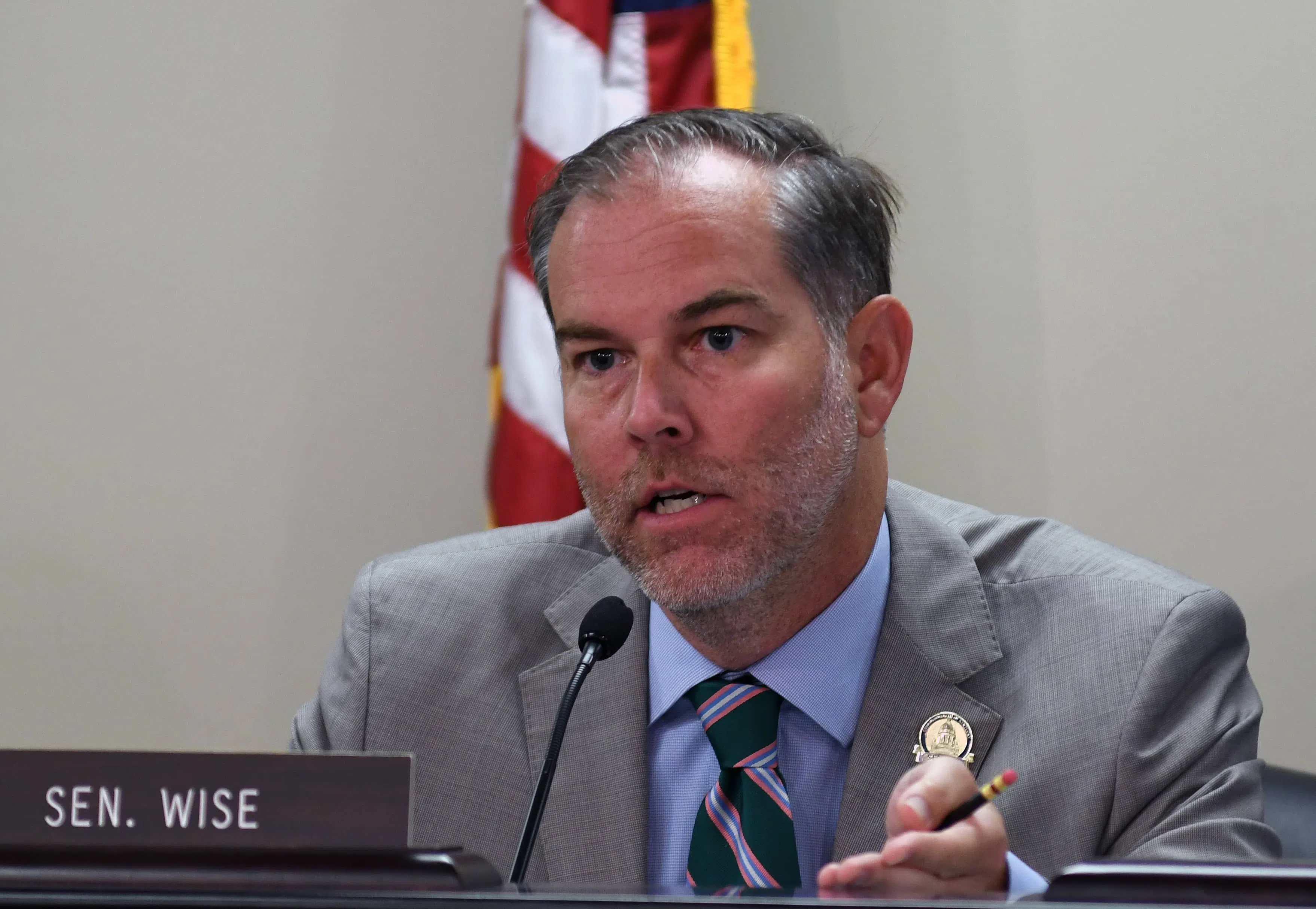
Committee co-chair Sen. Max Wise, R-Campbellsville, asks a question on school safety at the Interim Joint Committee on Education meeting on Friday.
(LEGISLATIVE RESEARCH COMMISSION)
FRANKFORT— The first day of school will be here soon, and safety is on the minds of parents, teachers, students and Kentucky lawmakers.
Jon Akers, the director of the Kentucky Center for School Safety, and Ben Wilcox, the state school security marshal with the Kentucky Department of Criminal Justice Training, spoke with lawmakers about school safety at the Interim Joint Committee on Education meeting on Friday.
In 2019, the legislature passed the School Safety and Resiliency Act, or Senate Bill 1, which transformed Kentucky’s approach to school safety. It established new school safety protocols and created the Kentucky Center for School Safety along with the position of school security marshal at the Kentucky Department of Criminal Justice Training.
The Kentucky General Assembly also passed House Bill 63 this year to require a school resource officer (SRO) at each school by Aug. 1 and to allow a school district to establish its own police department.
Wilcox said schools are safer today than they were three years ago.
“Our numbers are very, very good, and that will be shown in our report when it comes out in August,” he said.
The May 24 shooting at Robb Elementary School in Uvalde, Texas, where 19 students and two teachers were killed and 17 others were injured, was on the minds of lawmakers as they asked Akers and Wilcox questions.
“Is there anything that we’ve done, Senate Bill 1, the previous bills that we’ve worked on or passed? Is there anything there that we have in place that could have prevented what happened in Uvalde?” committee co-chair Sen. Max Wise, R-Campbellsville asked.
Wilcox said Kentucky already has a lot of safety measures in place through SB 1 from 2019.
“The School Safety and Resiliency Act requires exterior doors to be controlled access,” Wilcox said. “That means getting rid of what we call the ‘universal key.’ That’s that 5-pound rock that sits next to the door that props it open as teachers go out and in and making sure that those locks are actually working.”
Schools also practice what Wilcox called “layered security,” where interior doors at schools remained locked. Schools also practice lockdown drills.
“We’re at 99.7% compliance with closed, locked doors during instructional time and exterior doors as well,” he added.
As for SROs, Wilcox said those officers are trained to immediately respond at the first report or sound of gunfire, even if an SRO is the only officer on the scene. For an officer to become an SRO in Kentucky he or she must undergo 120 hours of specialized training, which includes active shooter training.
Rep. Lisa Willner, D-Louisville, expressed some concerns about SROs playing a role in discipline at schools and how that might disproportionally impact students of color.
Wilcox said state law does not allow SROs to be involved with discipline.
Sen. Alice Forgy Kerr, R-Lexington, pointed out that many of the people who become school shooters are young adults who dropped out or graduated the school they attack. She asked Akers if there is anyone keeping track of people who might be potential threats.
Akers said while many school shooters are young, white males, there is not an easy way to determine who might be a threat because sometimes a shooter is someone others would not think is capable of violence.
“That’s why we have the tip lines out there,” Akers said. “Somebody might know that (a person is a threat). We may not know that.”
Akers added that anytime law enforcement receives a tip about potential violence, they’re trained to investigate and take it seriously.
The next Interim Joint Committee on Education meeting is currently scheduled 11 a.m. on Aug. 16.
For the full interim calendar and other information on the Kentucky General Assembly, visit legislature.ky.gov.