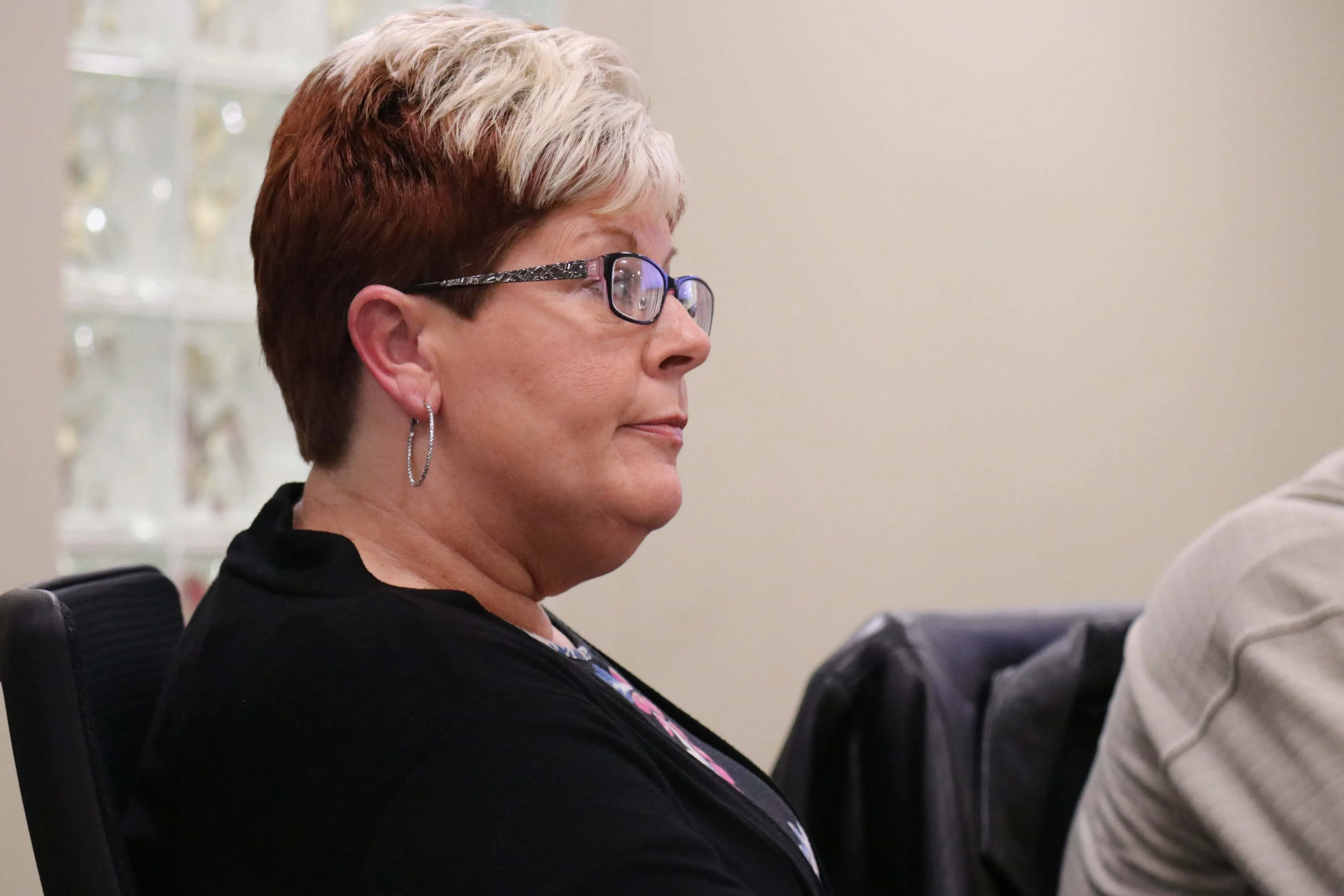
Libby Short, a board member of the Glasgow Electric Plant Board, listens during a meeting of the board on Tuesday, Jan. 28, 2020.
(WCLU NEWS FILE PHOTO)
GLASGOW, Ky. – A legal firm hired by the Glasgow Electric Plant Board nearly three years ago was dismissed at a special called meeting of the board on Monday.
The firm Cole & Moore was hired at a Jan. 20, 2017, meeting of the GEPB to represent three members who were facing a potential action by the Glasgow City Council that would unseat them.
John David Cole, with the law firm, was hired, according to the Glasgow Daily Times.
DT Froedge, board member, called for the firm to be removed as external legal counsel for the board. Most recently, the firm has served as the representation for Tag Taylor, chairperson, and Libby Short, secretary-treasurer. Both are members of the GEPB.
Froedge requested a declaratory judgement in Barren Circuit Court in May regarding several issues, including his membership validity. In that filing, four board members, including Marlin Witcher and Glen Pritchard, are named.
But confusion resulted in the potential firing.
“This firm has gone into court, without authorization of the board, advocating positions that are not consistent with motions of the board,” Froedge said. “This firm is active for the purpose of two members against three members, and they do not have authorization. There’s been no vote to allow them to go into court. And what they’re doing is unethical.”
Froedge reasoned the firm should not be employed by the GEPB while he privately pays attorneys for this suit.
“You are entitled to go into court for any reason – as am I,” Froedge said. “In my case, I’m paying my lawyers, and you are allowing the Glasgow Electric Plant Board to pay yours. This is on the part of the individual.”
However, Taylor said Cole was an authorized attorney for the board, given the negotiations from three years ago. He also said the suit is against the board, not himself.
“You are a board member, DT,” Taylor said. “But you are not the respondent in the case. You’re the plaintiff in the case. So, there’s a difference there.”
Ron Hampton, GEPB counsel, said the firm could represent any board member because they’re entitled to representation. However, a majority of the board must approve for its representation.
“I don’t know how an attorney can represent a client and go against that client, which operates by a majority,” Hampton said.
Witcher and Prichard, while named in the suit alongside Short and Taylor, “side” with Froedge. Thus, their votes were cast to cancel their representation, despite having used the counsel.
Short and Taylor took up the counsel after the suit was filed on May 18.
Prichard and Witcher have taken no action to disapprove of Froedge’s allegations. In fact, they have sided with them. Thus, the two voted alongside Froedge to oust Cole & Moore.
Taylor and Short disapproved of the action to remove the firm.
“For somebody to want to come in and strip us of our counsel – that’s just – I’m sorry, I’m just going to go ahead and be blunt. That’s just a punk move in my opinion,” Short said. “That’s the way it is. We’re entitled to counsel.”
Because the board hired the firm, the implication was that the firm could be used to represent the board. However, the “board” turned out to be two members only. The other members of the “board” essentially became plaintiffs alongside Froedge.
“In reality, anybody could turn around and sue any of you and name any of you in a suit at any time from this day forward,” Taylor said. “And you would be responsible, under the current proposal, you would be responsible for your own defense in your capacity as a board member. So, I don’t think we want to open up that can of worms.”
However, that can was opened.
Hampton said the situation is irregular because the board conflicts with itself. The defendants and plaintiff are all one unit, despite their differences.
Short interpreted, for the record, what Hampton had reasoned.
“So, in other words, what you’re saying then is DT can sue us as board members, however, we have to have DT sign off on who is our attorney?” Short said. “Come on.”
Hampton said he did not imply that but he did reinforce the idea that the attorneys used to defend the board must be approved by the board, and Froedge is a member of that board.
“If you’re taking the position of the board, then the board acts by a majority,” Hampton said. “If you don’t like the position of the majority, then you’re in the minority. And that’s just the way this board works.”
Taylor continued to explain his position against the removal of the external counsel. He said the action would only lead to harmful actions in the future.
“I’ve got a few months left on this board – not going to affect me as much as the rest of you,” Taylor said. “But I can assure you of this, if you let this go through today, you’re going to open yourselves up to many, many problems. People are going to jump on top of this like you’ve never seen anybody jump on top of things before to try to influence you and try to run you out of your position on this board.”
The election of officers was also on the agenda Monday, but Taylor said he would not allow the board to consider the item due to its “dilatory, absurdity and frivolous” nature.
“I would point out that the board is run by a majority, and there are no rules that supersede the majority of the vote on the board,” Froedge said. “This is a special called meeting to elect officers, and what you’re doing – even though you can suppress the vote – is not legal.”
Taylor and Short have filed an additional motion in Barren Circuit Court to stay additional attempts by Froedge and any other member in violation of the Open Meetings Act, SB 150 and a previous ruling handed down by Judge John T. Alexander.
The motion will be before the court on Thursday, Aug. 6 at 8:30 a.m.